Why Great Product Managers Think Visually
Discover how visual thinking helps PMs communicate complex ideas, make faster decisions, and align stakeholders using frameworks like mind maps and product trees.
Why Visual Thinking Matters for Product Managers
Great product managers don't just think in words—they think in pictures, diagrams, and frameworks. Visual thinking transforms abstract product concepts into tangible representations that teams can understand, discuss, and improve. When you communicate visually, complex ideas become accessible to everyone from engineers to executives.
Visual thinking means thinking in pictures, not words, which enhances attention, comprehension, and retention across your organization. This approach isn't just about making pretty slides—it's about creating shared understanding that drives better product decisions.
Three Core Benefits of Visual Thinking
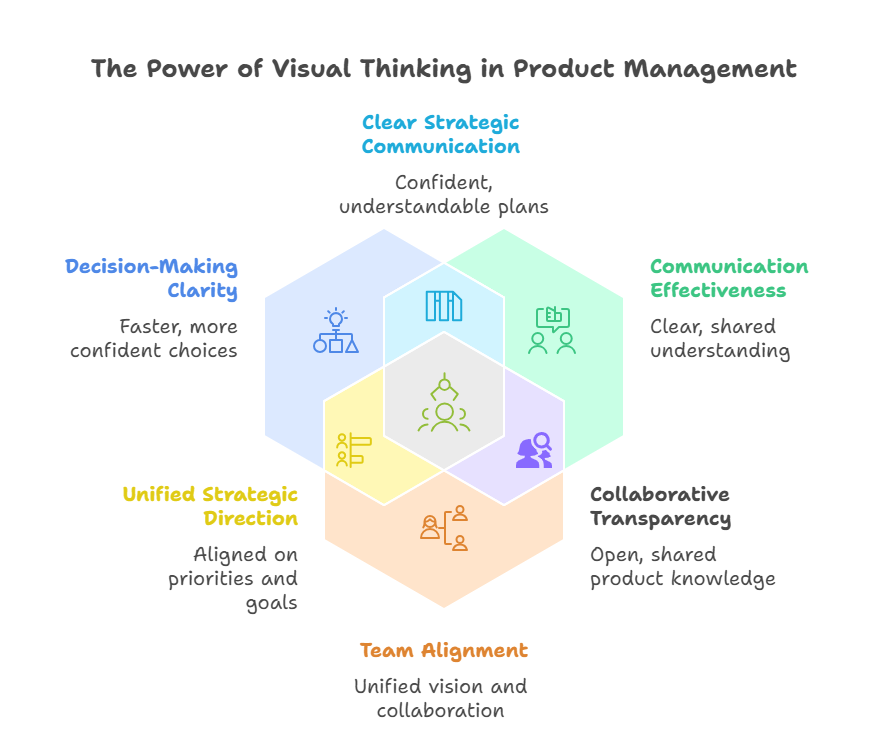
Make Better Decisions Faster
When you face complex product challenges, visual representation helps you deconstruct problems and understand the underlying factors more clearly. Seeing the entire problem space mapped out enables you to identify connections, spot gaps, and prioritize more effectively than text-based analysis alone.
Visual frameworks like mind maps allow you to organize information hierarchically, making it easier to see how different elements relate to each other. This clarity leads to more confident decision-making and reduces the time spent debating misunderstandings.
Communicate Complex Ideas Clearly
Product managers constantly bridge gaps between technical teams, business stakeholders, and customers. Visual communication makes messages easy to follow and digest, ensuring everyone understands the product vision, requirements, and constraints.
Designers often transition successfully into product management roles because their user-centric approach and visual communication skills translate perfectly to product leadership. They instinctively know how to make abstract concepts concrete through visual representation.
Align Cross-Functional Teams
Visual tools create shared artifacts that teams can reference throughout the product development process. When you use frameworks like product trees, you make abstract ideas visible, turning features, strategies, and dependencies into something everyone can point at and shape together.
This visual alignment reduces miscommunication and ensures that engineers, designers, marketers, and executives all share the same mental model of what you're building and why it matters.
Practical Visual Thinking Tools for PMs
Mind Maps for Strategic Planning
Mind maps provide a flexible structure for brainstorming product features, user journeys, and market opportunities. They help you capture and organize ideas without getting stuck in linear thinking patterns.
Product Trees for Feature Prioritization
The product tree framework visually represents your product's architecture, showing how different features connect and depend on each other. This makes it easier to discuss trade-offs and sequencing with your development team.
User Journey Maps for Empathy Building
Visualizing the complete customer experience helps your team understand pain points and opportunities from the user's perspective. These maps create alignment around what problems you're solving and why specific solutions matter.
Developing Your Visual Thinking Skills
Start by incorporating simple visual elements into your daily work—sketch diagrams during meetings, use sticky notes for brainstorming sessions, and create basic flowcharts for process discussions. The goal isn't artistic perfection but clear communication.
Practice translating complex concepts into simple visual metaphors. Ask yourself: "How can I represent this idea in a way that someone could understand in 30 seconds?" This mindset shift will transform how you approach product communication.
As you build confidence, explore more sophisticated visual frameworks and tools that support your specific product challenges. The ClipMind Free AI Tools platform offers various visual thinking aids that can help you get started quickly.
Visual Thinking as a Competitive Advantage
In today's fast-paced product environment, the ability to think and communicate visually isn't just nice to have—it's a fundamental skill that separates good PMs from great ones. Visual thinking accelerates decision-making, improves alignment, and ensures that complex ideas don't get lost in translation.
Whether you're presenting to executives, collaborating with engineers, or gathering customer insights, visual representations create the shared understanding that drives successful products forward. The most effective product leaders recognize that sometimes a simple diagram can communicate what thousands of words cannot.