What is a Value Proposition? A Guide for Product Managers
Learn what a value proposition is, why it's critical for product success, and how to craft a compelling one with practical examples and a free template.
What is a Value Proposition?
A value proposition is a clear, concise statement that communicates the unique value a customer will receive from your product or service. It's the core promise you make to your target audience, answering the fundamental question: "Why should I choose you?" As defined by Investopedia, it's a statement that communicates why a consumer should choose a company's product or service over competitors' offerings. This isn't just marketing fluff; it's a strategic tool that aligns your entire organization around delivering specific, measurable customer benefits.
Think of it as the bridge between a customer's problem and your solution. A strong value proposition articulates the problem you're solving and makes a compelling case for your company as the problem-solver. It focuses on the measurable benefits a prospective customer can expect, moving beyond features to highlight the tangible outcomes and "superpowers" the user gains.
The Core Components of a Strong Value Proposition
An effective value proposition isn't a vague slogan. It's built on specific, interconnected elements that resonate with your target customer's needs and desires.
- Target Customer: It speaks directly to a specific audience and their unique challenges.
- Problem Solved: It clearly identifies the pain point or need your product addresses. As noted by NZTE, it articulates the problem you're solving for your target customers.
- Key Benefit: It promises a specific, desirable outcome or gain. ProductPlan emphasizes that it identifies the measurable benefits customers can expect.
- Differentiator: It explains why your solution is better than the alternatives, including competitors or the status quo.
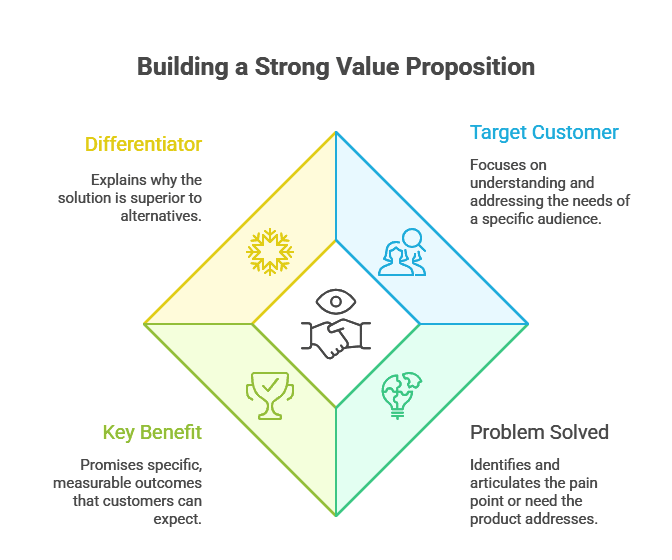
Crafting a value proposition that hits all these points can be challenging. To structure your thinking visually, try using a mind map. ClipMind offers AI-powered tools to help you brainstorm and organize these core components into a coherent strategy.
Why Your Value Proposition is Non-Negotiable
In a crowded market, a weak or unclear value proposition is a significant liability. It serves as your foundational strategic anchor.
- Guides Product Development: It ensures every feature and update delivers on the core promise to the customer.
- Focuses Marketing Messaging: It provides a consistent message across all channels, from your website to social media ads.
- Informs Sales Conversations: It equips your sales team with a clear, compelling reason for customers to buy.
- Builds Brand Cohesion: A strong value proposition, like the one championed by Komenda for affordable design, helps build a cohesive brand identity that resonates with a specific customer motivation.
Perhaps most importantly, a value proposition is not set in stone. As highlighted by Help Scout, the best value propositions evolve with your customers. By continuously listening to customer feedback, you can adapt your promise to meet their changing needs.
How to Craft and Test Your Value Proposition
Creating your value proposition is an iterative process of research, drafting, and validation.
Start with Customer Insight Your value proposition must be rooted in a deep understanding of your customer. Conduct interviews, analyze support tickets, and study market reviews to pinpoint their primary frustrations and desired outcomes. Avoid focusing on the product itself; instead, focus on the holistic impact on the customer's life, as suggested by Shopify's guide.
Draft and Refine Write a simple statement using this formula: "For [target customer] who [need or opportunity], our [product/service] provides [key benefit]. Unlike [competition/alternative], we [primary differentiator]." Keep it short, specific, and benefit-oriented.
Validate and Evolve Test your draft with real potential customers. Does it grab their attention? Does it clearly explain what you offer and why it's better? Use their feedback to refine it. Remember, if you find yourself relying on hype to sell, it may be a sign your value proposition isn't well-defined or your product isn't as valuable as you think. A compelling promise should stand on its own merits.
For a structured approach to this process, you can use ClipMind's free AI SWOT Analyzer to understand your competitive position or the AI Competitor Analyzer to clarify your differentiation.
Putting It All Together: Your Strategic Promise
A value proposition is more than a tagline; it's your strategic promise to the market. It defines the unique value you deliver, focuses your team's efforts, and communicates clearly to customers why you are their best choice. By grounding it in customer reality, focusing on benefits, and committing to its evolution, you turn this simple statement into a powerful driver of product success and customer loyalty.
Start defining your value today. Map out your customer's problems, your solution's benefits, and your key differentiators to build a promise that resonates and delivers.