How to Use Jobs-to-be-Done Framework for Product Success
Learn how to apply the Jobs-to-be-Done framework to understand customer needs, prioritize features, and build products people actually want to use.
What is Jobs-to-be-Done Framework?
The Jobs-to-be-Done (JTBD) framework is a customer-centric approach that shifts focus from product features to understanding why customers use products in the first place. Instead of asking what features to build, JTBD asks "What job is the customer hiring this product to do?" This methodology helps teams understand user motivation and design solutions that help customers accomplish their most important goals Jobs to Be Done Framework: A Guide for Product Teams.
The framework originated from Tony Ulwick's work at Strategyn, where the approach has been used since 1991. Companies applying JTBD have achieved an impressive 86% success rate in developing and improving their products by focusing on solving customer problems rather than building features.
Why JTBD Matters for Product Teams
Traditional product development often focuses on features and specifications, but JTBD flips this perspective. The framework helps teams:
- Understand the real problem customers are trying to solve
- Prioritize development based on job importance rather than feature requests
- Build products people actually need and love to use
- Separate customer needs from solutions to avoid building the wrong features
As one product manager noted on Reddit, JTBD is excellent for understanding the problem space and driving prioritization based on the importance of job steps.
How to Implement JTBD in 4 Steps
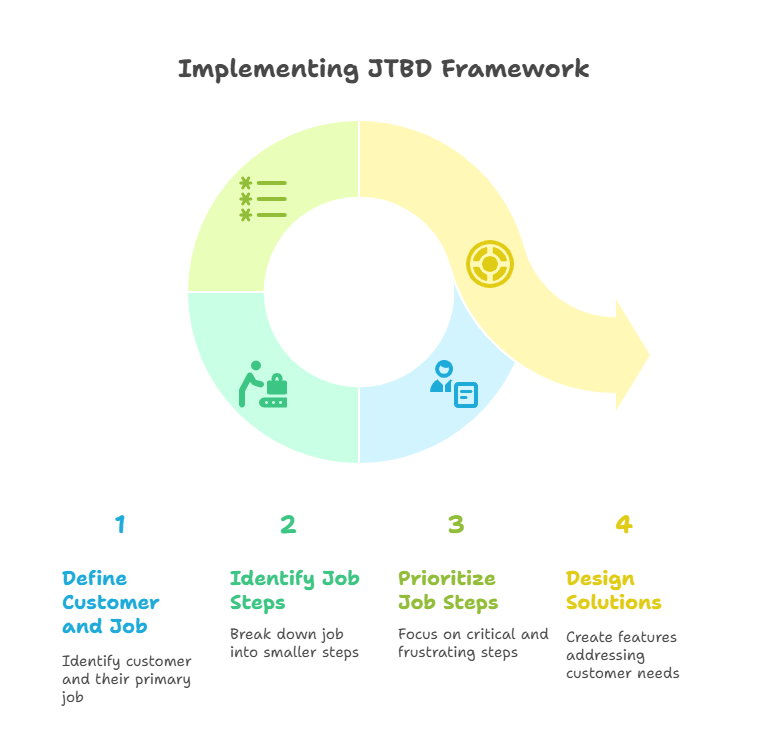
Define Your Customer and Their Primary Job
The first step involves identifying who your customer is and what primary job they're trying to accomplish. Work directly with customers through interviews and observation to understand their goals and motivations. The job should be framed as a statement describing what the customer wants to achieve, not how they might achieve it Jobs-to-be-Done | A Comprehensive Guide.
For example, instead of "build a faster database," the job might be "organize customer information for quick retrieval during sales calls."
Identify Job Steps and Context
Break down the primary job into smaller steps and understand the context in which customers perform these jobs. Consider:
- What triggers the need for this job?
- What steps do customers take to complete the job?
- What obstacles do they encounter?
- What defines successful completion?
This step-by-step analysis helps you understand the complete customer journey and identify pain points where your product can provide the most value.
Prioritize Based on Job Importance
Not all job steps are equally important to customers. Use customer research to identify which steps are most critical and which cause the most frustration. This prioritization ensures you focus development efforts on areas that will deliver the most customer value JTBD drives prioritization based on importance.
Design Solutions for the Job
With a clear understanding of the job and its most important steps, you can now design solutions that help customers complete their jobs more effectively. The JTBD approach ensures you're building features that directly address customer needs rather than adding functionality that doesn't solve real problems.
Practical JTBD Applications
The Jobs-to-be-Done framework works particularly well for:
- Product discovery and ideation
- Feature prioritization and roadmap planning
- Competitive analysis and positioning
- Customer segmentation and targeting
- Innovation and new market entry
By focusing on the job rather than the customer demographic, JTBD helps identify opportunities that might be missed with traditional segmentation approaches.
Visualizing Your JTBD Analysis
Mapping out jobs-to-be-done can be complex, with multiple job steps, contexts, and customer scenarios to consider. Using visual tools like mind maps can help organize your JTBD analysis and communicate insights across your team. ClipMind offers AI-powered mind mapping tools that can help you structure and visualize your JTBD framework analysis, making it easier to identify patterns and opportunities.
For product teams looking to streamline their JTBD analysis, consider using ClipMind's Free AI Tools to organize customer insights and job mapping exercises more effectively.
Common JTBD Mistakes to Avoid
While implementing JTBD, watch out for these common pitfalls:
- Focusing on features instead of jobs - Remember you're solving for the job, not building features
- Overcomplicating job statements - Keep job descriptions clear and actionable
- Skipping customer research - JTBD requires deep customer understanding through direct engagement
- Ignoring context - The same job can have different requirements in different situations
The Jobs-to-be-Done framework provides a powerful lens for understanding customer behavior and building products that truly meet user needs. By shifting focus from what you're building to why customers need it, you can create more successful products that people actually want to use.