How to Optimize Landing Pages for Higher Conversions
A practical guide to landing page optimization (LPO) with actionable tips to improve conversion rates, backed by data and expert advice.
What is Landing Page Optimization (LPO)?
Landing page optimization is the systematic process of improving the elements on a dedicated web page to increase the percentage of visitors who complete a desired action, such as signing up, downloading, or purchasing. It's not just about aesthetics; it's a data-driven discipline focused on aligning the page with user intent and removing friction. The impact is significant: an optimized landing page can generate a 160% higher conversion rate for actions like sign-ups compared to other lead generation tools. For product managers and marketers, this translates directly to more efficient ad spend and higher ROI from campaigns.
Core Principles of an Effective Landing Page
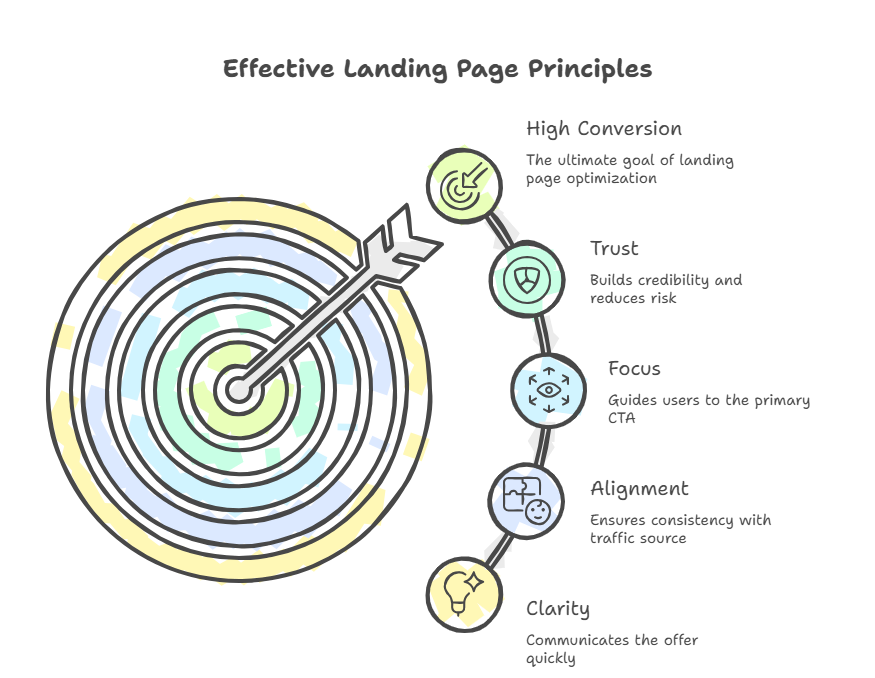
Before diving into tactics, it's crucial to understand the foundational principles that make a landing page work. A high-converting page is built on clarity, relevance, and a frictionless user journey.
- Clarity of Offer: Visitors should understand what you're offering within seconds. The value proposition must be unmistakable.
- Alignment with Traffic Source: The messaging on your landing page must be consistent with the ad, email, or social post that brought the visitor there. As noted in PPC discussions, you must make sure landing pages are consistent with communication in your assets.
- Singular Focus: Every element should guide the user toward one primary call-to-action (CTA). Remove navigation links and distractions that could lead visitors away.
- Building Trust: Use elements like testimonials, security badges, and logos to establish credibility and reduce perceived risk.
Actionable Landing Page Optimization Tips
Moving from theory to practice, here are key areas to test and improve based on expert guidance and conversion data.
Craft a Compelling Headline and Value Proposition
Your headline is the first thing visitors read. It must immediately confirm they're in the right place and hint at the benefit. Experts emphasize the need for strong, relevant headlines that match the user's search intent. Follow it with a clear sub-headline that elaborates on the core value. Is your value proposition clear? Use our AI Title Generator to brainstorm impactful headline variations.
Optimize Page Speed and Technical Performance
A slow page is a conversion killer. Decreasing page load time is a non-negotiable best practice. Compress images, leverage browser caching, and minimize code. Tools like Google PageSpeed Insights can provide specific recommendations. Remember, a delay of even a few seconds can cause a significant drop in conversions.
Strengthen Social Proof and Trust Signals
People look to others for validation. Incorporate customer testimonials, case studies, trust badges, and logos of known clients or partners. As one guide suggests, test adding other customer logos, partner logos, a customer case study, testimonials, or other forms of social proof. This evidence helps overcome skepticism and builds confidence in your offer.
Design a Clear and Persuasive Call-to-Action (CTA)
Your CTA button is the gateway to conversion. Make it visually prominent with a contrasting color. Use action-oriented, benefit-driven text like "Get My Free Guide" or "Start Your Free Trial" instead of generic "Submit." Ensure the CTA is placed above the fold and repeated logically throughout the page.
Refine Your Forms
Forms are often the biggest point of friction. Only ask for information you absolutely need. Use smart defaults and clear field labels. Consider using progressive profiling for returning visitors. The key is to balance the value of the lead with the effort required to submit.
The Optimization Process: Test, Analyze, Iterate
Optimization is not a one-time task but a continuous cycle. The most successful teams adopt a structured approach.
- Analyze and Hypothesize: Use analytics and session recordings to identify drop-off points. Form a hypothesis (e.g., "Changing the CTA color to green will increase clicks by 5%").
- A/B Test: Create a variation of your page with the single change you want to test. Use a dedicated landing page optimization tool that allows you to run experiments and determine statistical significance.
- Learn and Implement: Run the test until you have a clear winner. Implement the winning variation and use the insights to inform your next hypothesis.
Modern approaches even leverage AI, where systems can automatically send each visitor to the landing page variant where they’re most likely to convert, maximizing overall campaign ROI.
Visualizing Your Optimization Strategy with ClipMind
For visual thinkers like product managers and marketers, organizing these complex variables is key. A mind map is an ideal tool to structure your landing page optimization framework, connecting principles, test ideas, and results.
You can use ClipMind, an AI-powered productivity platform, to create a dynamic mind map of your optimization strategy. Start with your core goal (e.g., "Increase eBook sign-ups by 20%") and branch out into key areas like Headline, CTA, Social Proof, and Page Speed. ClipMind allows you to clip research, add notes from your A/B tests, and keep your entire optimization roadmap in one visual, connected space. This helps ensure no element is overlooked and your strategy remains cohesive.
Landing page optimization is a powerful lever for growth. By focusing on user intent, removing friction, and committing to a cycle of continuous testing, you can systematically improve your conversion rates and get more value from every visitor.