How to Handle Product Failures and Turn Setbacks into Growth
Learn practical strategies for handling product failures, conducting effective post-mortems, and transforming setbacks into valuable learning opportunities for your team.
Reframe Your Perspective on Product Failure
Product failure isn't just a possibility in product management—it's a certainty that tests the resilience of both your product and your team. As product leaders emphasize, the key isn't about avoiding failure altogether but learning from it, adapting, and coming back stronger. This mindset shift transforms failure from a setback into a growth engine for your product, team, and personal development.
Many products fail due to poor product/market fit, meaning there aren't enough customers willing to pay for them. According to industry analysis, customers ultimately define the value of a product, not the company. Even successful companies with loyal customers can have product failures when people don't find new items compelling.
Conduct Effective Product Post-Mortems
When products fail, conducting a structured post-mortem is crucial for maximizing learning and growth. As Geoff Charles explains, these meetings should focus on reviewing why the product failed as a team and identifying learnings that can increase the odds of success next time.
Key elements of an effective product post-mortem include:
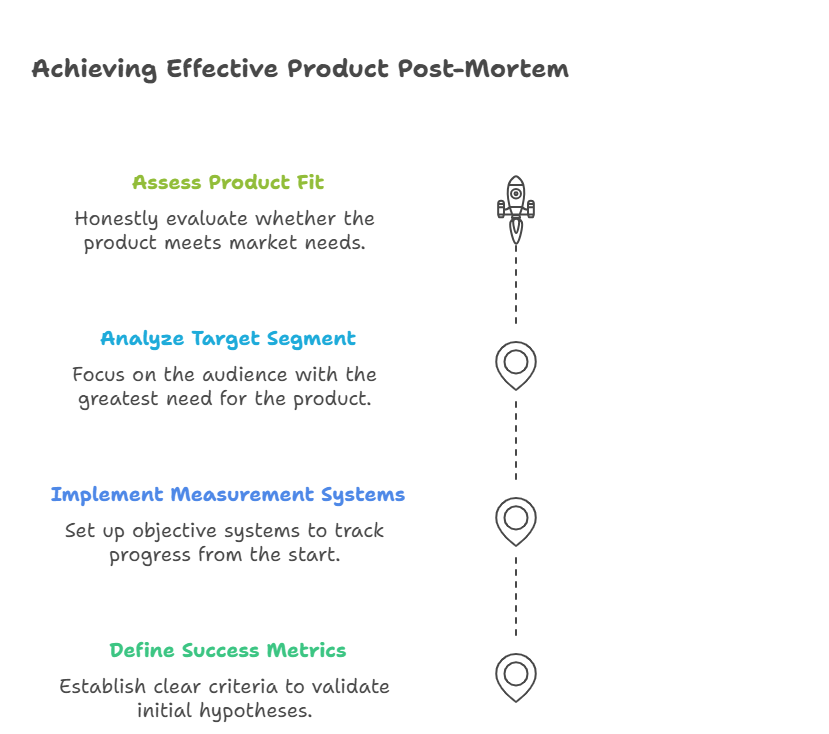
- Clearly defined success metrics that validate your initial hypothesis
- Objective measurement systems implemented from the start
- Target segment analysis focusing on the audience with the biggest need
- Honest assessment of whether you built the wrong product
Analyze Market Fit and Customer Needs
Understanding why products fail often comes down to fundamental market dynamics. Research shows that selling a few early products may be a good start, but it doesn't necessarily prove there will be enough customers in the future to make a viable market. You need a critical mass of individuals or companies who face similar problems and will pay for your solution.
To avoid product failure, business experts recommend monitoring social and technology trends, studying customer reviews and complaints, and pinpointing what established products still get wrong. Understanding your target market's price sensitivity is equally important—consider your customers' household income and how willing they are to spend more on your type of product.
Validate Your Target Segment
Before launching, clearly define your target segment, focusing on the audience that has the biggest need for your solution. Many companies launch new products that fail because they don't align with customer needs or stray too far from their core market. Use tools like ClipMind's STP Analyzer to systematically evaluate your segmentation, targeting, and positioning strategy.
Learn from Famous Product Flops
Studying famous product failures provides valuable lessons for any product manager. These case studies reveal common patterns and pitfalls that can help you avoid similar mistakes in your own product development process.
Key lessons from product flops include:
- Don't assume early traction means sustainable demand
- Stay aligned with your core market strengths
- Customers define value, not your internal team
- Test assumptions rigorously before scaling
Build a Failure-Resilient Team Culture
Creating an environment where teams can learn from failure requires intentional cultural building. As product leaders note, the most eye-opening failures often shape how product managers approach new challenges. Encourage your team to share their failure experiences and the lessons they've learned.
For B2B products, effective launches require account-based strategies, targeted advertising, and interactive product demos. Invest in employee training that includes extensive product knowledge to create powerful ambassadors who can confidently convey product benefits and understand customer pain points.
Implement Continuous Learning Systems
The most successful product teams don't just react to failures—they build systems for continuous learning and improvement. Use mind mapping tools from ClipMind to visualize failure patterns, identify root causes, and document lessons learned for future projects.
By treating each product failure as a data point rather than a personal failure, you create an environment where innovation can thrive. The goal isn't perfection but continuous improvement and adaptation based on real-world feedback and market response.