How to Do Competitor Benchmarking: A Step-by-Step Guide
Learn a practical 5-step framework for effective competitor benchmarking. Identify rivals, choose metrics, gather data, analyze gaps, and drive strategic improvements.
What is Competitor Benchmarking?
Competitor benchmarking is the systematic process of comparing your business’s most important metrics and KPIs against those of your rivals How to do competitor benchmarking with public data sources. It’s a type of business benchmarking where you evaluate your performance in relation to direct competitors to gain invaluable insights for strategic decision-making Competitive Benchmarking in 2025: Best Practice Guide. This practice moves beyond simple observation, turning data into actionable competitive benchmark metrics you can measure against your own company's performance.
The goal is not to copy but to understand industry standards, identify performance gaps, and uncover opportunities for improvement. By harnessing the power of competitive benchmarks, you can drive continual improvement and position your business as a leader in your industry.
A 5-Step Framework for Effective Benchmarking
A structured approach ensures your benchmarking efforts are focused and yield actionable results. Here is a consolidated, practical framework based on industry best practices.
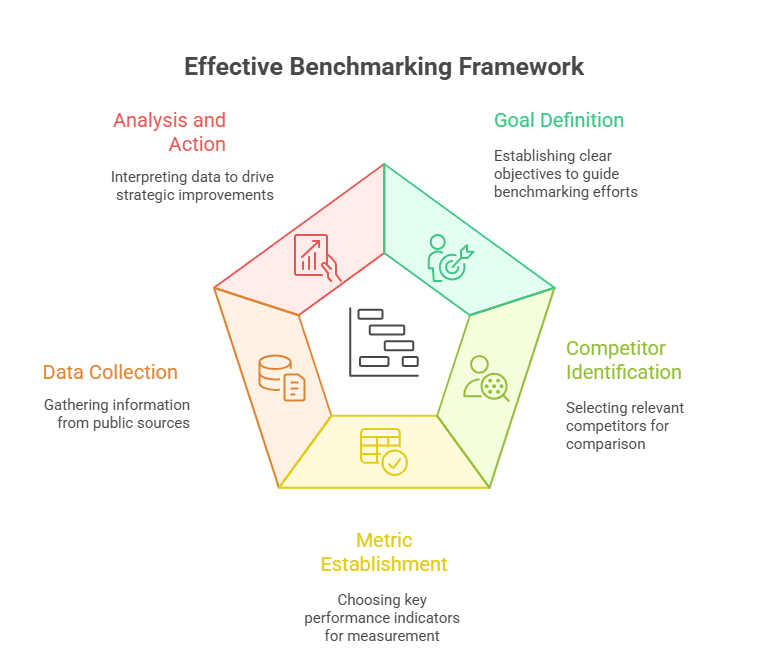
Step 1: Define Clear Goals and Objectives
Start by uncovering your business’s goals and working backwards to identify the most important KPIs to measure How to do competitor benchmarking with public data sources. Ask yourself what you want to achieve. Are you looking to increase market share, improve customer satisfaction, boost social media engagement, or enhance your SEO ranking? Your objectives will directly dictate which competitors you analyze and what metrics you track. Without clear goals, you risk collecting data that is interesting but not useful.
Step 2: Identify and Shortlist Your Competitors
Not all rivals are worth benchmarking against. Create a list that includes both direct competitors (those offering similar solutions) and aspirational competitors (industry leaders). As noted by Yoav Morder, Search and PR Director, criteria for selection should include niche, size, region, and, most importantly, who poses a danger to your business in terms of competitiveness How to do competitor benchmarking with public data sources. A tool like ClipMind’s AI Competitor Analyzer can help you systematically identify and categorize these players, saving you hours of manual research.
Step 3: Establish Key Benchmarking Metrics
Choose metrics that align with your goals from Step 1. Common categories include:
- Market & Web Presence: Market share, website traffic share, and traffic sources What Is Competitive Benchmarking? A 101 Guide for Beginners.
- Digital Marketing: SEO performance, social media engagement rates, follower growth, and share of voice in online conversations.
- Business Performance: In the absence of direct sales data, use proxies like estimated web traffic or social media followers as rough indicators of market presence What Is Competitive Benchmarking? A 101 Guide for Beginners.
Step 4: Collect Data from Public Sources
This step involves gathering intelligence. You can uncover your competitors’ guarded data using public data connectors—be that their social media profiles, review sites like Yelp, or brand mentions in press releases How to do competitor benchmarking with public data sources. Utilize specialized tools:
- For web and SEO: Tools like Semrush or SimilarWeb can show traffic share splits and source breakdowns.
- For social media: Platforms like Talkwalker’s Social Benchmarking tool can generate data about your competitors’ social media presence and compare it to your own, showing "social media market share" What Is Competitive Benchmarking? A 101 Guide for Beginners.
Organizing this disparate data is crucial. Visual tools like mind maps can help you see connections and patterns that spreadsheets might miss.
Step 5: Analyze, Compare, and Act
Turn raw data into insights. Compare the collected metrics against your own performance. Identify where you are leading, where you are at parity, and where significant gaps exist. The critical question is: Why? Is a competitor's higher engagement due to their content style, posting frequency, or community management? This analysis should directly inform your strategic actions, leading to a plan for improvement, whether it's refining your marketing mix, adjusting product features, or reallocating resources.
Turning Insights into a Strategic Action Plan
The final value of benchmarking lies in execution. Create a clear action plan from your findings. Prioritize initiatives based on the size of the performance gap and the potential impact on your business goals. Assign owners and set timelines. Remember, competitor benchmarking is not a one-time project but a cycle of continuous improvement Competitive Benchmarking in 2025: Best Practice Guide. Schedule regular reviews to track your progress against benchmarks and to see how the competitive landscape evolves.
To streamline this entire process—from research to analysis to planning—consider using an integrated platform. ClipMind allows you to clip data from various sources, organize insights visually with AI-powered mind maps, and build your strategic plan in one cohesive workspace.