How to Analyze Marketing ROI: A Practical Guide for 2024
Learn how to measure and improve marketing ROI with a step-by-step guide, key metrics, and tools to prove your campaign's financial impact.
What is Marketing ROI and Why It Matters
Marketing ROI, or Return on Investment, is the financial return generated from your marketing activities relative to their cost. At its core, it answers a fundamental business question: are your marketing campaigns making money? As defined by Salesforce, you calculate it by comparing the money gained from a campaign to the money spent on it. This metric is a crucial tool for understanding campaign effectiveness and justifying marketing budgets to stakeholders. Without a clear view of ROI, you're essentially investing in the dark, unable to distinguish profitable strategies from wasteful spending.
The Core Formula and Key Metrics for Analysis
The basic formula for marketing ROI is straightforward: (Revenue from Marketing - Marketing Cost) / Marketing Cost. This gives you a percentage that represents your return. A 200% ROI means you earned $2 for every $1 spent. However, applying this formula requires tracking the right inputs.
To move beyond a simple calculation, you need to measure specific performance indicators. According to insights from Business.com, revenue is the most crucial metric for determining true ROI. Other essential metrics include:
- Cost Per Acquisition (CPA): The cost to acquire a single paying customer.
- Customer Lifetime Value (CLV): The total revenue a customer is expected to generate over their relationship with your business.
- Conversion Rates: The percentage of leads that complete a desired action, like making a purchase.
- Lead Generation: The number of sales-qualified leads produced by a campaign.
For experiential or brand-focused campaigns, you might also track social media engagement and brand awareness. The key is to align your metrics with your campaign's specific goals, whether that's direct sales, lead generation, or brand building.
A 5-Step Framework to Analyze Your Marketing ROI
Analyzing ROI is a process, not a one-time calculation. Follow this structured framework to build a complete picture of your marketing performance.
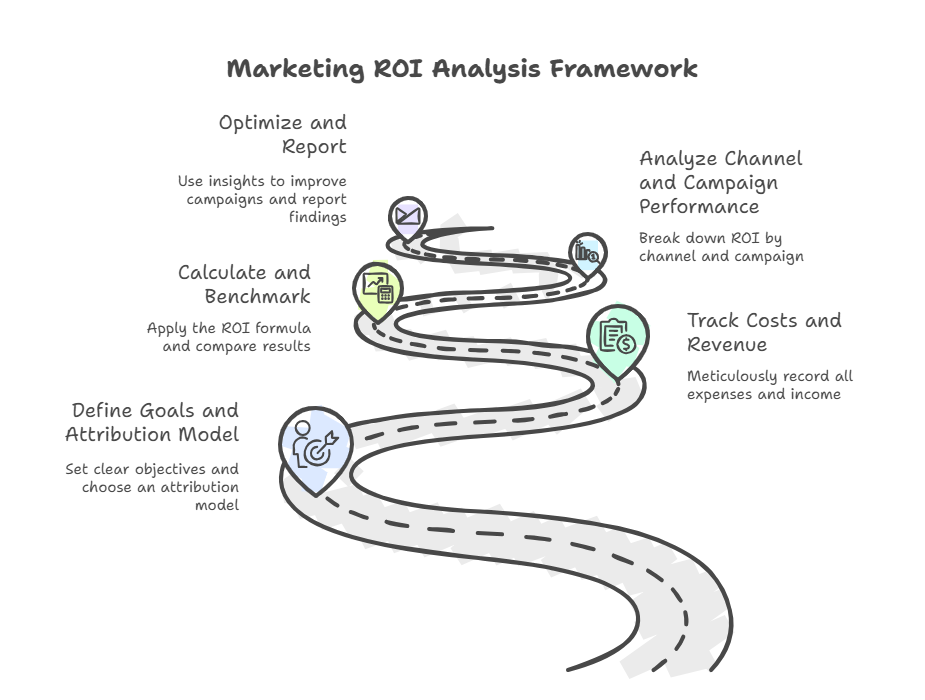
Step 1: Define Goals and Attribution Model
Start by setting clear, measurable objectives for each campaign. Is the goal to generate $50,000 in sales, acquire 500 new leads, or increase website traffic by 30%? Simultaneously, decide on your attribution model—how you credit a sale to a marketing touchpoint. Will you give full credit to the last click, or distribute it across multiple interactions? This decision dramatically impacts your perceived ROI.
Step 2: Track Costs and Revenue Meticulously
You cannot calculate ROI without accurate financial data. Knowing how much you spend at each stage of your campaigns is essential to improving marketing ROI, as noted by Business.com. Track all costs: ad spend, software subscriptions, agency fees, and internal labor. On the revenue side, use tracking pixels, UTM parameters, and CRM integration to connect sales back to the marketing activities that drove them.
Step 3: Calculate and Benchmark
Apply the ROI formula using your collected data. Then, benchmark your result. Compare it against your company's target ROI, historical campaign performance, or industry averages. A positive ROI is good, but context is everything. An ROI of 150% might be outstanding for a brand-awareness campaign in your industry but subpar for a direct-response product launch.
Step 4: Analyze Channel and Campaign Performance
Break down your overall ROI by marketing channel (e.g., email, social media, PPC) and individual campaigns. ROI tools allow you to determine which marketing channels and campaigns have the greatest impact on sales and revenue. This granular analysis helps you identify your highest-performing tactics and reallocate budget from underperforming areas.
Step 5: Optimize and Report
Analysis is pointless without action. Use your findings to optimize future campaigns. Double down on what works and revise or eliminate what doesn't. Finally, compile your analysis into a clear report for decision-makers. As recommended in a guide on B2B marketing ROI analysis, learn to speak in financial terms to demonstrate marketing's concrete contribution to business growth.
Essential Tools for Marketing ROI Analysis
Manually tracking ROI across complex, multi-channel campaigns is nearly impossible. Specialized tools are essential. As highlighted by Ruler Analytics, ROI tools are an absolute must for anyone serious about tracking marketing effectiveness. These platforms break down data silos between marketing and sales, providing a unified view of performance.
Key types of ROI tools include:
- Marketing Attribution Platforms: Tools like Ruler Analytics connect offline conversions to online marketing touchpoints.
- Analytics Suites: Google Analytics, when properly configured with goals and e-commerce tracking, is a foundational tool.
- CRM & Marketing Automation: Platforms like Salesforce and HubSpot track the entire customer journey from lead to revenue.
- Campaign Management & Budgeting: Tools like Planful help marketers track goals, campaigns, budgets, and return on investment in one place.
The right tool stack provides the data integrity and automation needed to move from guessing to evidence-based decision-making.
Turning Analysis into Action: How to Improve Marketing ROI
Improving your ROI is the ultimate goal of analysis. One of the most effective strategies is personalization. By successfully using personalization to improve ROI, you can build deeper relationships with customers. Tailored email campaigns, targeted ad messaging, and personalized website experiences consistently yield higher conversion rates and customer value.
Other actionable tactics include:
- Refining your target audience to reduce wasted ad spend.
- Improving website conversion rates through A/B testing.
- Nurturing leads more effectively to increase conversion velocity.
- Focusing on retaining existing customers, as retaining a customer is often more cost-effective than acquiring a new one.
Regular ROI analysis creates a feedback loop where every campaign provides data to make the next one more efficient and profitable.
Mastering marketing ROI analysis transforms your role from a cost center to a proven revenue driver. By implementing a clear framework, tracking the right metrics, and leveraging modern tools, you can demonstrate the undeniable value of your work and strategically guide your company's growth.