How to Use AI Tools in Product Management: A Practical Guide
Learn how product managers can leverage AI tools for data analysis, automation, and decision-making to streamline workflows and drive product innovation.
The AI Revolution in Product Management
Product management is undergoing a fundamental transformation as artificial intelligence reshapes how we work. AI's capabilities in data analysis, predictive modeling, and automation provide product managers with unparalleled tools to enhance decision-making, streamline processes, and drive innovation. While some fear AI might make product managers obsolete, the reality is quite different—AI is becoming just another essential tool in our toolkit.
The most forward-thinking product teams are already leveraging AI to analyze market trends, customer feedback, and competitive data while suggesting improvements to existing products or entirely new product concepts. By aligning strategies with data-backed insights, product managers can ensure their products meet customer expectations and stand out in competitive markets.
Key Areas Where AI Transforms Product Management
Data Analysis and Customer Insights
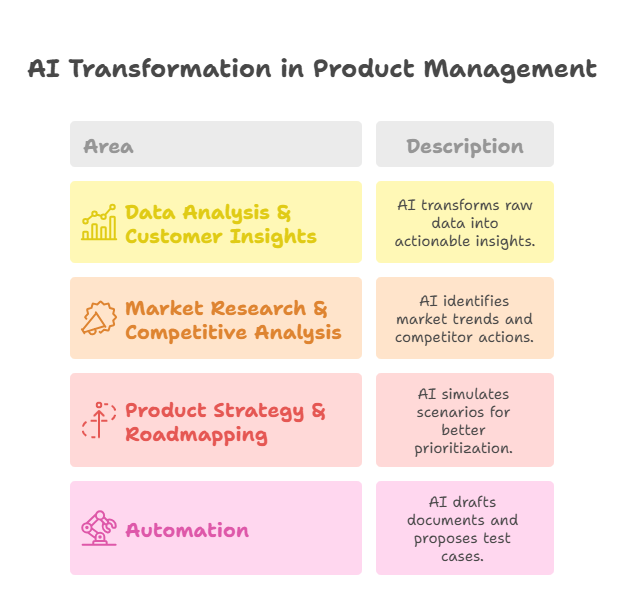
AI-powered analytics tools can process vast amounts of user behavior data, transforming raw information into actionable insights. Machine learning algorithms analyze patterns in user interactions, while natural language processing helps synthesize customer feedback from multiple sources. This enables product managers to make data-driven decisions based on comprehensive understanding rather than gut feelings.
Intelligent assistants can draft product requirement documents, auto-generate user stories aligned to goals, and even propose test cases—cutting spec-writing time by 50% or more. This automation frees up product managers to focus on strategic thinking and customer engagement.
Market Research and Competitive Analysis
AI tools excel at scanning the competitive landscape and identifying emerging market trends. By analyzing competitor announcements, customer reviews, and industry reports, AI can provide early warnings about market shifts and new opportunities. This proactive approach helps product teams stay ahead of the curve rather than reacting to changes.
Product Strategy and Roadmapping
AI can simulate different product scenarios and predict potential outcomes based on historical data and market conditions. This helps product managers create more accurate roadmaps and make better prioritization decisions. By harnessing AI-driven tools and strategies, product managers can unlock new opportunities for growth, efficiency, and innovation while overcoming the challenges associated with AI integration.
Practical AI Tools for Product Managers
Documentation and Specification Tools
AI writing assistants can dramatically reduce the time spent on creating product documentation. From PRDs to user stories and release notes, AI tools help maintain consistency and completeness while adapting to your team's specific terminology and style guidelines.
Feedback Synthesis Platforms
Tools that aggregate customer feedback from multiple channels—support tickets, app reviews, social media—and use NLP to identify common themes and sentiment trends are invaluable. They help product managers understand what customers truly want without manually sifting through thousands of comments.
Predictive Analytics Engines
Advanced analytics platforms use machine learning to forecast user behavior, feature adoption rates, and potential churn risks. These insights enable proactive product decisions and help allocate resources to the highest-impact initiatives.
Implementing AI in Your Product Workflow
Start with Specific Use Cases
Rather than attempting a complete AI transformation overnight, identify specific pain points where AI can provide immediate value. Common starting points include customer feedback analysis, competitive intelligence gathering, or documentation automation. Focus on customer-centricity, fostering collaboration, and embracing experimentation to successfully navigate AI integration.
Build AI Literacy Across Your Team
Ensure your product team understands both the capabilities and limitations of AI tools. Provide training on effective prompt engineering, data interpretation, and ethical considerations. Remember that AI should augment human judgment, not replace it entirely.
Measure Impact and Iterate
Track how AI tools affect your team's productivity, decision quality, and product outcomes. Look for measurable improvements in time savings, error reduction, or customer satisfaction. Use these metrics to justify further AI investments and refine your approach.
Overcoming Common AI Implementation Challenges
Data Quality and Integration
AI tools are only as good as the data they process. Ensure you have clean, well-structured data sources and consider how different systems will integrate with your AI solutions. Many teams struggle with siloed data that limits AI effectiveness.
Balancing Automation with Human Oversight
While AI can automate many routine tasks, product strategy requires human judgment and creativity. Establish clear guidelines for when AI recommendations require human review and maintain oversight of critical decisions.
Managing Organizational Resistance
Some team members may be skeptical about AI tools or concerned about job security. Address these concerns transparently by emphasizing how AI enhances rather than replaces human capabilities, allowing product managers to focus on higher-value work.
The Future of AI in Product Management
As AI technology continues to evolve, product managers who master these tools will have a significant advantage. The most successful teams will be those that learn to be better product managers in a world where AI is just another tool in our toolkit. By focusing on strategic thinking, customer empathy, and ethical considerations—areas where humans excel—while leveraging AI for data processing and automation, product managers can drive unprecedented innovation.